The browser you are using is not supported. Please consider using a modern browser.


How to Compare Natural Gas Rates in Georgia
Learn how to navigate the state's deregulated energy market. We cover how to compare, choose, and switch natural gas providers in the Atlanta Gas Light service territory to secure the best fixed rates.

Key Takeaways
- Georgia residents in the Atlanta Gas Light (AGL) service territory can choose their natural gas supplier to secure competitive rates.
- Natural gas in Georgia is priced per therm (or CCF). Average fixed rates typically range from $0.55 to $0.85 per therm, plus utility pass-through charges.
- Atlanta Gas Light is the state's natural gas utility. It’s primary responsibility is to maintain the natural gas pipeline infrastructure.
- Your total bill consists of AGL Pass-Through Base Charges (pipeline delivery and meter maintenance) and your chosen Marketer’s Supply Rate (the gas you burn).
Table of Contents

Shop the Best Natural Gas Rates in Georgia
Sweet tea, peaches, and Bulldogs football aren’t the only things Georgians care about. When winter rolls in and you need to keep your home warm, nothing matters more than locking in the best natural gas rates in Georgia. This guide will show you how to compare Georgia natural gas rates, understand your bill, and shop like a pro.
How Does Georgia Gas Choice Work?
Depending on where they live, Georgians can purchase natural gas from three different types of providers including natural gas marketers (aka providers), investor-owned local distribution companies, or a municipal gas system. These providers buy natural gas at wholesale prices and then sell you the actual natural gas.
- The Natural Gas Competition and Deregulation Act of 1997 allows Georgia residents served by Atlanta Gas Light to choose their natural gas provider. This deregulated market fosters competition, leading to stable, market-based rates from certified providers.
- Residents in Cataula, Harris County, Columbus, and surrounding areas are served by Liberty Utilities, the only local natural gas distribution company in Georgia. Liberty Utilities is fully regulated by the Georgia Public Service Commission.
- 84 municipal gas systems provide natural gas to all other Georgia residents. Prices for municipal gas service are not subject to PSC regulation.
The Georgia Public Service Commission (PSC) is responsible for certifying natural gas providers and overseeing the utility distribution framework. To obtain a certificate, natural gas providers must demonstrate the technical and financial capacity to sell natural gas within the state of Georgia.
Difference Between Utility and Gas Supplier
Under the Natural Gas Competition and Deregulation Act of 1997, Georgia’s natural gas market was split into two distinct roles: pipeline maintenance and energy supply.
- The Utility (Atlanta Gas Light): AGL does not sell natural gas directly to consumers. Instead, it owns and maintains the physical underground distribution pipelines, reads your meter, and responds to gas emergencies. You cannot choose your utility provider; it is determined by where you live.
- The Marketers (Suppliers): Natural gas marketers buy wholesale gas and sell it directly to consumers. You have the legal right to shop around and choose whichever certified marketer offers the lowest per-therm rate and favorable contract terms.
Understanding Your Natural Gas Bill in Georgia
Unlike most states, where utility providers handle gas bills, Georgia’s gas bills are paid directly through your energy provider.
In Georgia, there are three parts to your natural gas bill:
- Gas Usage Charge (Supply): This is calculated as Therms Used × Marketer Commodity Rate. For example, using 100 therms at $0.60/therm equals a $60.00 supply charge.
- Marketer Customer Service Fee: A flat monthly fee charged by your supplier (typically ranges from $4.95 to $9.95/month).
- AGL Pass-Through Charge: A regulated fee set by Atlanta Gas Light to cover pipe maintenance and system capacity. This charge varies seasonally based on your Dedicated Dedicated Delivery Capacity (DDDC) factor and is collected by your marketer on AGL’s behalf.
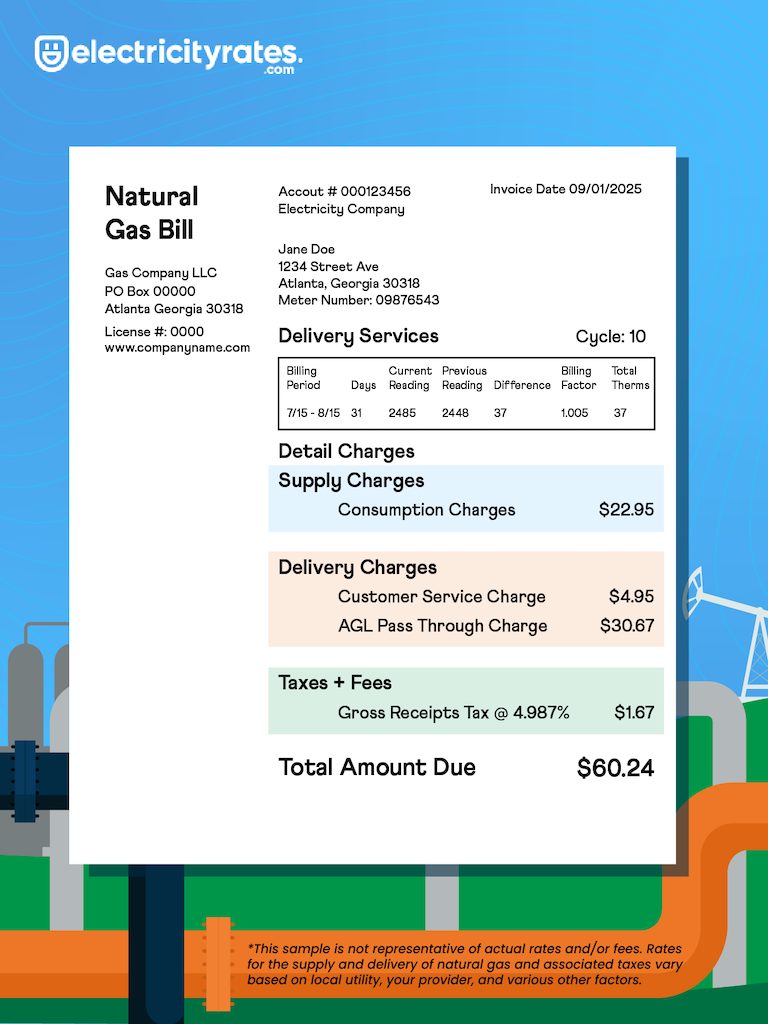
Note: Even if you switch marketers, AGL’s pass-through charges remain the same.
How to Compare Natural Gas Rates in Georgia
Comparing Georgia gas rates doesn’t have to be harder than deciding between Zaxby’s or Chick-fil-A (tough call, we know). Evaluate these four key criteria before enrolling:
Here’s what to do:
- Know your usage → Check your past bills to see how much you use in a typical month.
- Compare plan options → Evaluate if a fixed-rate or variable-rate plan is right for you. With a fixed rate, you lock in a single rate per therm for 6, 12, 24, or 36 months. With a variable-rate plan, rates change monthly based on market conditions. While flexible with no long-term commitment, rates can rise sharply during peak demand months.
- Look beyond the headline price → Some marketers advertise low initial rates that automatically convert to higher variable rates after 1 to 3 months. All plans listed on ElectricityRates.com are pre-vetted fixed plans with transparent pricing terms.
- Read the fine print before enrolling → Early termination fees (ETF) will be found here. If you cancel a fixed-rate contract before the term ends, suppliers typically charge an ETF (ranging from $50 to $150). Always select a term length that matches your housing plans.
Note: We recommend a fixed-rate plan for budget stability against winter price spikes.
Certified Georgia Natural Gas Providers
There are over a dozen PSC-certified marketers operating in Georgia. Below is an overview of major residential suppliers:
Constellation

- Provider Score™ 4.83 / 5
- Energy Options
- Service Areas CT, DC, GA, IL, MA, NJ, OH, PA, TX
Provider Bio
Constellation is the nation's leading provider of carbon-free energy with a commitment to be 100% carbon-free by 2040. They serve over 2.5 million residential and business customers across the United States.
Gas South

- Energy Options
- Service Areas GA, VA
Provider Bio
Gas South is one of the largest natural gas providers in the Southeastern United States, serving over 445,000 residential, commercial, and industrial customers across multiple states with a strong commitment to community giving and sustainability.
Xoom Energy

- Provider Score™ 4.59 / 5
- Energy Options
Provider Bio
Xoom Energy is an independent energy provider that provides natural gas and electricity services in 19 states and over 100 utility markets nationwide. As one of the fastest-growing energy providers in the US, Xoom Energy was listed on the Forbes Inc. 5000 list in 2015, 2016 and 2017.


Why Switch Providers?
Average Natural Gas Prices in Georgia
- Lower Your Overall Energy Costs: On average, natural gas rates in Georgia hover around 73.8¢ to 82.9¢ per therm, depending on the provider. Shopping lets high-usage homes lock in lower therm rates and low-usage homes cut fixed monthly fees.
- Protect Your Budget from Winter Spikes: Locking in a fixed-rate plan shields you from seasonal market volatility, avoiding the costly variable rates that default plans charge during peak cold months.
- Capitalize on Perks and Incentives: Competing natural gas marketers offer bill credits, waived security deposits, and specialized discounts for seniors, military personnel, and first responders.
What are the Best Natural Gas Rates in Georgia?
Natural gas is a big deal in Georgia. In 2024, natural gas accounted for 41% of Georgia’s total electricity generation. The “best” rate depends on your goals, but here’s the good news: Georgia is one of the few states with natural gas choice.
That means you’re not stuck with a single provider— if you’re an Atlanta Gas Light customer, you can choose your natural gas provider in Georgia. Atlanta Gas Light serves Atlanta, Marietta, Alpharetta, Savannah, and the surrounding areas.
The Georgia Public Service Commission regularly publishes a Marketers’ Pricing Index so you can see who’s charging what. It’s like a gas-price menu—minus the drive-thru window.
Commercial Natural Gas Rates in Georgia
Businesses in Georgia also benefit from natural gas choice. About 130,000 businesses in Georgia already use natural gas, representing 50% of all companies in the state. Commercial natural gas rates in Georgia are based on your electricity usage, contract size, and location.
Industries from food service to data centers rely heavily on natural gas for heating and operations. With Georgia’s booming economy, commercial demand is rising—and locking in stable rates can help businesses avoid shocks to the bottom line.
New to Georgia? How to Set Up Natural Gas Service
If you’re moving to Georgia, welcome to the neighborhood.
Here’s the playbook to make sure you get the lowest natural gas rates:
- Contact Atlanta Gas Light to confirm service availability at your new address.
- Easily shop and select a natural gas provider on Electricityrats.com.
- Enroll in a plan online or by phone if you have questions.
- Schedule your service start date.
FAQs about Natural Gas in Georgia
-
Locking in a fixed-rate Natural Gas plan gives you price protection and peace of mind that your bill will not fluctuate unexpectedly. This allows you stick to your household budget and spend time worrying about things other than your gas bill.
-
Current residential natural gas rates in Georgia start around 63.9¢ per therm for fixed plans, with all-in average rates ranging from about 73.8¢ to 82.9¢ per therm depending on the provider. Comparing Georgia gas rates and understanding the terms helps ensure you get the best rate.
-
The Atlanta Gas Light (AGL) Pass-Through Charge is a regulated base fee for pipeline delivery, meter reading, and emergency system maintenance. AGL charges this fee to deliver gas to your home regardless of which natural gas marketer you choose.
-
Natural gas in Georgia is measured and billed in therms (or CCF), representing the actual amount of energy consumed. When evaluating a rate, factor in the supplier’s flat Monthly Customer Service Fee (usually $4.95 to $9.95 per month), as low-usage households save more by choosing a lower monthly fee over a minor difference in therm price.
-
When a fixed-rate contract expires without a renewal agreement or supplier switch, your marketer will automatically convert your account to a standard variable-rate plan. Variable rates fluctuate monthly with market volatility and are often significantly higher than fixed terms—especially during winter heating months. To prevent unexpected price hikes, compare and select a new fixed-rate plan 30 to 60 days before your contract term ends.
-
In Georgia, retail choice is deregulated for natural gas, but electric service is strictly regulated. Residential customers cannot shop for alternative electricity suppliers; electric service is assigned by geographic territory through Georgia Power, local Electric Membership Cooperatives (EMCs), or municipal electric cities. Natural gas choice is available to all residents located within the Atlanta Gas Light (AGL) service territory.